

Your Excellency, the Special Envoy of the United Nations for the Great Lakes Region, Huang Xia
Your Excellency, the Special Envoy of the African Union for Women, Peace and Security, Ambassador Liberata Mulamula
Distinguished Members of the Advisory Board for Women, Peace and Security,
Representatives of the United Nations, the African Union, MONUSCO, UN Women, ICGLR, GIZ, ACCORD and all partner organisations,
Honoured facilitators of the African-led peace process for the Democratic Republic of Congo,
Representatives of regional civil society networks and humanitarian organisations,
Distinguished guests,
ladies and gentlemen,
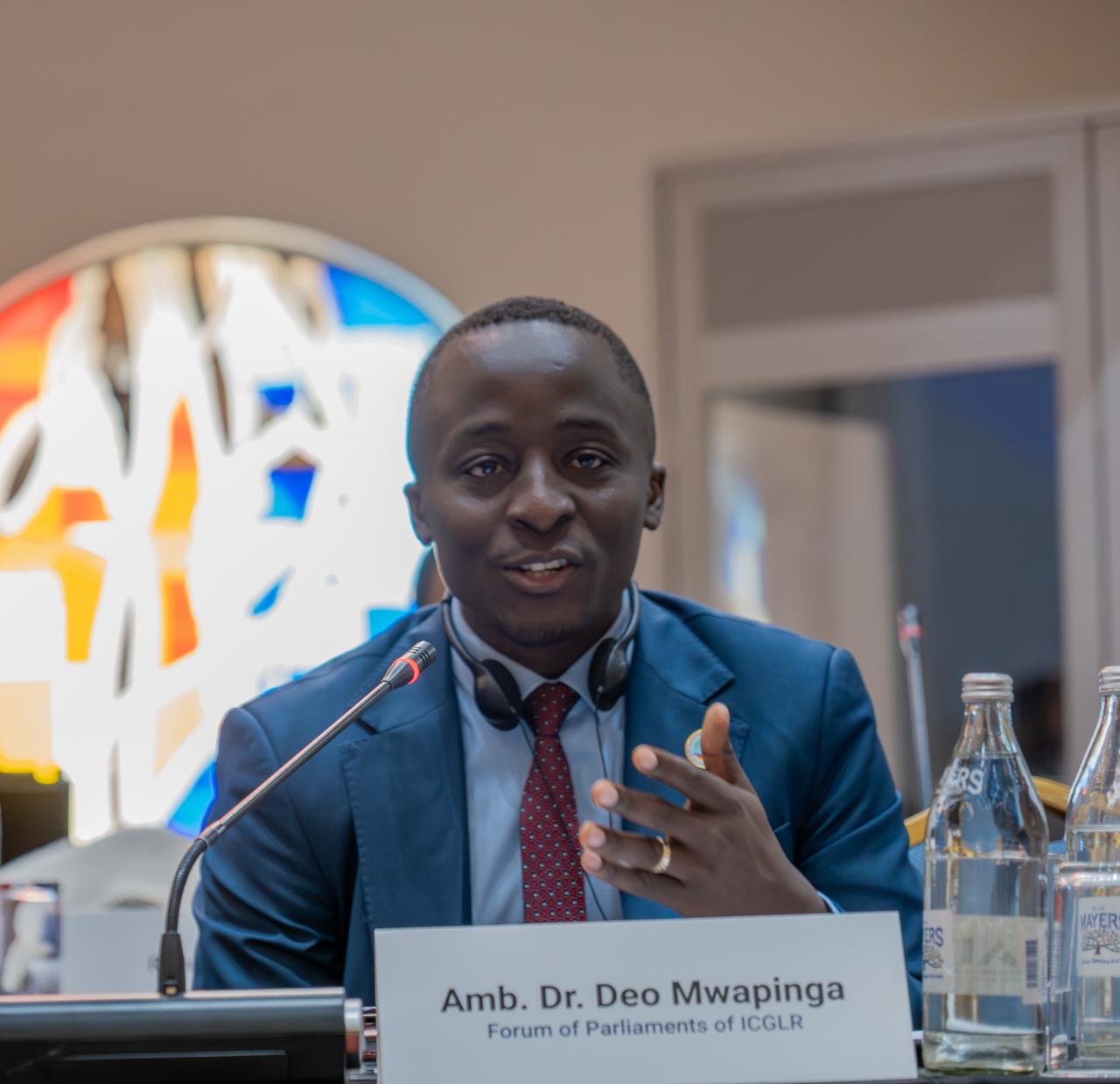
Let me begin by saying that I am honored to be invited in this gathering and given an opportunity to address this distinguished gathering on behalf of the Forum of Parliaments of the International Conference of the Great Lakes Region. Allow me to extend the warmest greetings from the twelve member parliaments of the Great Lakes Region, and to express our sincere gratitude to the organisers for bringing together such an exceptional assembly of leaders, practitioners and advocates at this critical moment for regional peace.
This High-Level Strategic Meeting of the Advisory Board for Women, Peace and Security convenes at a defining moment. The Great Lakes Region stands at a crossroads. Without further emphasis, our region have suffered a lot. The solution to these enduring challenges needs a paradigm shift. We need political accountability to get out of these challenges.
The Forum of Parliaments of the ICGLR is the parliamentary arm of the International Conference of the Great Lakes Region. Our mandate is rooted in the Pact on Security, Stability and Development, and we exercise our role through legislative oversight, regional dialogue, and the promotion of inclusive governance. We believe, firmly and without reservation, that lasting peace cannot be achieved without the full, meaningful and equal participation of women — in our parliaments, in our peace processes, and in our communities.
The United Nations Security Council Resolution 1325 on Women, Peace and Security has long served as our compass. Building on the momentum of its 25th anniversary and the Secretary-General's Common Pledge for Women's Participation, the FP-ICGLR has moved from affirmation to action. The ICGLR Regional Action Plan on Women, Peace and Security provides a structured framework to operationalise UNSCR 1325 across our twelve member states — integrating the four pillars of Participation, Protection, Prevention, and Relief and Recovery into the fabric of our parliamentary work.
Yet we recognise that frameworks alone are not enough. They must be animated by political will, resourced by partnerships, and anchored in the lived realities of the women and communities they are meant to serve.
It is in this spirit that the FP-ICGLR has taken a decisive step forward.
Ladies and gentlemen, allow me to share with you a development that fills the Forum with immense pride and determination: the upcoming Women's Parliamentary Conference of the Great Lakes Region — the WPC — to be held in Dar es Salaam, United Republic of Tanzania, from 2 to 5 November 2026.
This is the first-ever Women's Parliamentary Conference of the Great Lakes Region. It was born out of a direct recommendation of the 15th Plenary Assembly of the FP-ICGLR, held in Luanda, Angola in April 2025, under the theme of Inclusive Leadership and Decision-Making. The Assembly identified the persistent underrepresentation of women — who today account for only 28 per cent of parliamentarians in our region —well, mathematical this number is low. But lets be frank here, it is not about numbers, it is about meaningful participation. We can have 10% representation, or 70%, and still have unsatisfied results.
We see the Women's Parliamentary Conference not as an isolated event, but as a structural contribution to the implementation of UNSCR 1325 and the ICGLR Regional Action Plan on WPS. It is a platform where legislative power meets lived experience — where the voices of women peacebuilders, which this Advisory Board has so faithfully amplified, will be channeled into policy, law and regional commitments.
The work of this Advisory Board and the mandate of the FP-ICGLR are deeply complementary. The Advisory Board's unique role — bridging grassroots peacebuilding and high-level diplomacy — mirrors what the WPC seeks to do: connect the wisdom of communities and civil society with the decision-making power of legislatures.
The FP-ICGLR welcomes and fully supports this meeting's twin purpose: strengthening the Advisory Board's strategic role within regional peace processes, and creating space for civil society networks and Centres of Excellence to engage directly with the facilitators and mediation actors of the DRC peace process. These are not separate agendas — they are two pillars of the same architecture.
We take particular note of the shrinking funding landscape for the WPS agenda and its impact on women-led and youth-led organisations. The FP-ICGLR is committed to using its parliamentary platform to advocate for the protection and expansion of WPS financing — at the national level through budget oversight, and at the regional level through our engagement with development partners and international institutions.
Excellencies, distinguished participants,
The 25th anniversary of UNSCR 1325 reminded us of how far we have come — and how far we still have to go. Women remain underrepresented in peace negotiations, in parliaments, and in the institutions that shape the futures of our communities. The conflict in the eastern DRC continues to impose disproportionate suffering on women and girls. The protection gaps are real. The participation deficits are structural. The recovery needs are urgent. But so is our collective determination.
This Advisory Board, the regional peace facilitators, the civil society networks, the United Nations, the African Union, and the parliamentary community of the Great Lakes Region — we form a web of commitment and capability that, when coordinated, is formidable.
The FP-ICGLR brings to this partnership the legitimacy of elected institutions and the power of law. We ask of this meeting: let us leave Nairobi with not only strengthened coordination and analysis, but with a shared resolve to ensure that the Women's Parliamentary Conference of November 2026 becomes a turning point — a moment at which the Great Lakes Region demonstrates, before Africa and the world, that its parliaments are true champions of women, peace and security.
Let us honour the courage of the women peacebuilders of this region. Let us honour the mandate entrusted to us by our peoples. And let us build, together, a Great Lakes Region that is peaceful, inclusive and developed.
I thank you.