

· Honourable Daniel Baran Sillo, Deputy Speaker of the Parliament of the United Republic of Tanzania;
· Honourable Dr. Dorothy Gwajima, Minister of Community Development, Gender, Women and Special Groups;
· Hon Dr Tulia Ackson, The President of the Interparliamentary Union (IPU)
· Hon Eng Ezra Chiwelesa, MP, President of the Committee on Humanitarian and Social Issues of the Forum of Parliament of ICGLR
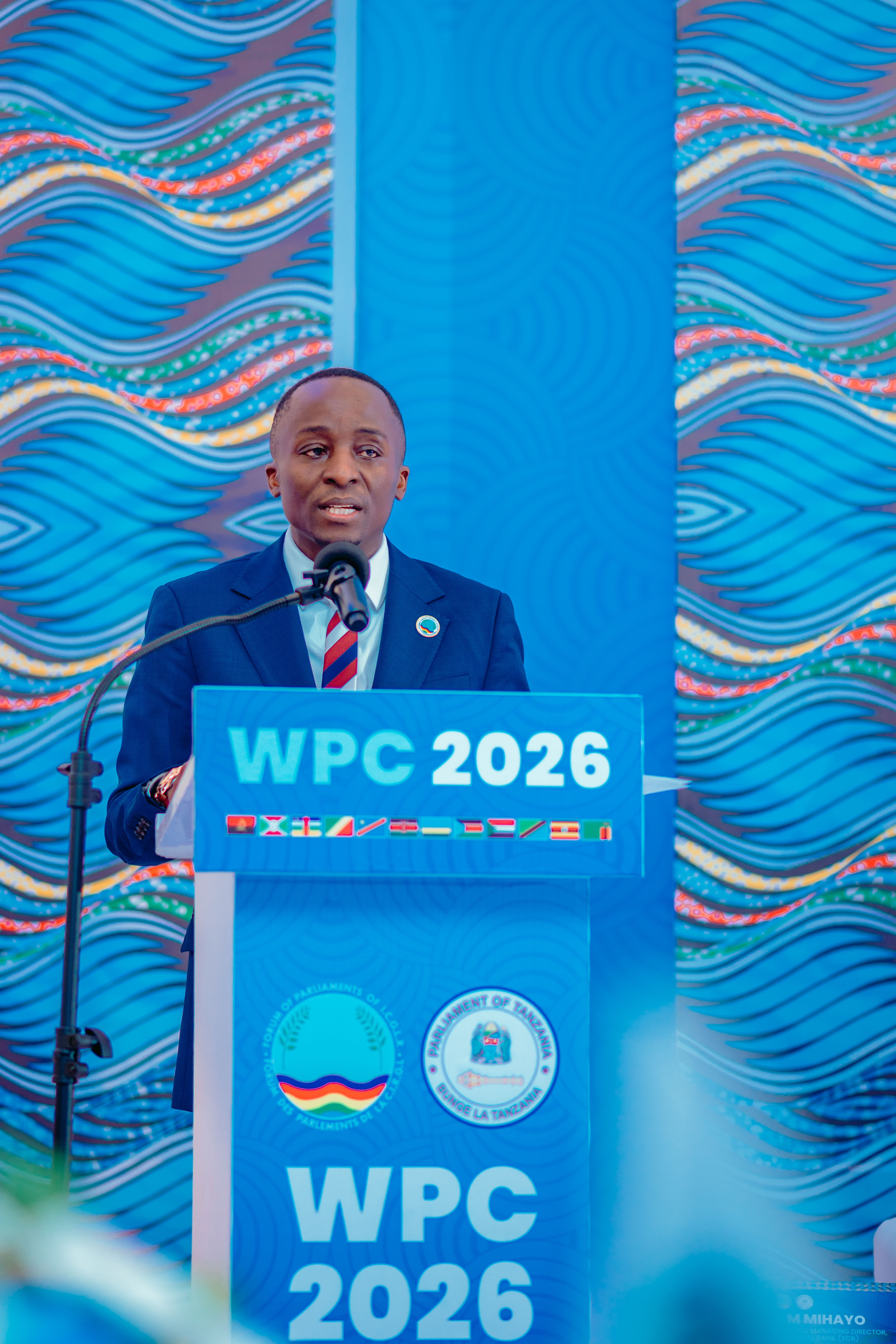
· Mr. Adam Mihayo, CEO and Managing Director of Tanzania Commercial Bank-our gracious main sponsors of the WPC,
· I acknowledge the presence of HE Julia Brossard, UN Women Country Representative, Ms Danai Lazaris who is representing, Ireland Ambassador in Tanzania, and
· Our Sponsors and Partners in attendance, ATCL- CEO Eng Ulanga, Director of Marketing and Trade from TFC, Director of HRM-TRC,
· Editors and journalists
· Representatives from CSOs, our dear online volunteers
· Ladies and Gentlemen
A very good morning to you all!
Before I start giving my opening remarks allow me to say that on behalf of the Member States of the ICGLR Forum of Parliaments and my own behalf, I extend my condolences to Her Excellency President Dr Samia Suluhu Hassan, the Government, and the people of Tanzania following the death of Hafidh Ameir Hassan, the First Gentleman. This loss impacted our region deeply, as we are united by bonds of solidarity and shared purpose. The Forum of Parliaments expresses its support to President Samia and the Tanzanian people during this difficult time, praying that the family finds strength and solace in the coming days. Amen!
Distinguished Officials and Partners
I want to start my remark by giving a historical context of the ICGLR. In November 2004, leaders from this region gathered here in Dar es Salaam to confront the legacy of war, the Rwandan Genocide, and the mass displacement that followed. President Benjamin Mkapa, then President of the United Republic of Tanzania, welcomed them to this city, which he called the ‘haven of peace’, and set a standard I would like to borrow this morning. He said: “We have not assembled here for mere recitals of our problems, but for investing in a better future for all our people.”
President Mkapa was, of course, speaking of the need to translate our commitments into action. This morning, allow me to take his words in a second sense: The Women Parliamentary Conference, which will convene from 2nd to 5th November, 2026, here in Dar es Salaam, is intended not only to recite the issues facing the women of our region but also to provide a space where actionable policy, commitments on peace, security and development, viewed through a gendered lens, will be developed. Indeed, this spirit has guided the Forum of Parliaments and its partners in organising the Conference.
Distinguished Officials,
In the early 20th century, architects revolutionised the world with three simple words: ‘form follows function’. These words became a fundamental slogan for proponents of functionalism as a theory of regional integration. The premise holds that a building’s structure must be dictated by its practical purpose, not by decorative ornament. Today, in the ICGLR family-when we talk about regional integration, we often marvel at shared currencies, open borders, and booming trade agreements. We treat these economic arrangements as the goals themselves. But engineering teaches us a brutal truth: you cannot build a soaring, beautiful structure on shifting sand. I say this to reiterate the undeniable significance of peace, security, and inclusion as foundations of development and prerequisites for advancing the regional integration agenda.
Distinguished Officials
Allow me now to briefly explain why this Conference will take place here in Tanzania.
First, Tanzania is the birthplace of many of this region’s peace and security initiatives. The ICGLR itself is a product of the 2004 Dar es Salaam Declaration, and Tanzania is remembered across the continent for its role in the liberation of much of Africa, having hosted the Southern Africa Liberation Committee and for spearheading a united, peaceful and prosperous continent.
Second, Tanzania offers a living example of the gender mainstreaming this Conference is tailored to advance. Here in Tanzania, women hold prominent positions across our political and decision-making bodies, form the backbone of our informal economy, and make up a significant share of our agricultural workforce, demonstrating a cross-cutting reality across members of the ICGLR.
Third and most importantly, Tanzania is home to the region’s first female Head of State and, indeed, the first woman elected President of the United Republic of Tanzania. This demonstrates that women are breaking the ceiling that our patriarchal societies have long embraced. This factor makes Tanzania an especially fitting place to convene a conference dedicated to women’s leadership.
Distinguished Officials
Through this gathering of women parliamentarians, we hope the voices of women from across our region will be heard through their parliamentarians, who are the primary democratic representatives. Notably, the inclusion of non-state actors, including members of civil society, women-led organisations, and youth networks. All this is set to bring the diversity of perspectives this conversation deserves.
The four-day conference is set to cover a wide range of topics. We will examine peace and security, in particular the implementation of United Nations Security Council Resolution 1325 on Women, Peace and Security. The issue of sustainable resource management as a precondition for economic growth, and the need for a gender-responsive legislative architecture to guide the mineral sector.
Furthermore, 70% of the population on our continent is made up of young people, with a median age of 35, making it the youngest continent in the world. The extent to which we can capitalise on these young minds to further innovation and technological advancement by instituting relevant legislation to support this group will also be part of the agenda of the respective Conference.
Distinguished Officials,
The Ebola outbreak in the Democratic Republic of Congo, the very strong El Niño now forecast for the months ahead, and the continuing displacement of people across our region are matters of real and pressing significance; not least for women, who so often stand on the front line as social and economic actors in times of crisis. Our discussions on these issues will give stakeholders a moment to reflect on how women and society more broadly are affected by regional insecurity, and on how we might respond and recover together.
Globally, too, our economies remain vulnerable. Prices for energy sources such as oil and gas continue to surge, driven in part by the ongoing conflict in the Middle East. This insecurity ripples through the cost of goods and services, making life harder for ordinary people. Additionally, the growing uncertainty surrounding global multilateralism is a reminder, once again, of how important it is for the Global South to build its own channels, platforms, and spaces where our issues can be tabled and our own solutions found. This is what I call a south-south cooperation. Put otherwise, African problems for Africa-led solutions.
For all these reasons, this Conference is timely. At its heart, it takes up the question posed by classical feminist scholarship, particularly advanced by Cynthia Enloe, in which she asked: “Where are the women?” This question has long exposed how women’s voices are marginalised in matters of peace, security, and development. Through this first-ever Conference, we hope to make our own empirical contribution: to the deconstruction of theory, the shaping of policy, and the practice of international relations and regional integration.
Before I close, I am honoured to once again welcome you all to the Women Parliamentary Conference, taking place at the Julius Nyerere Convention Centre from 2nd to 5th November 2026.
Thank you, and I wish us all productive days ahead as we look forward to this important conference.
